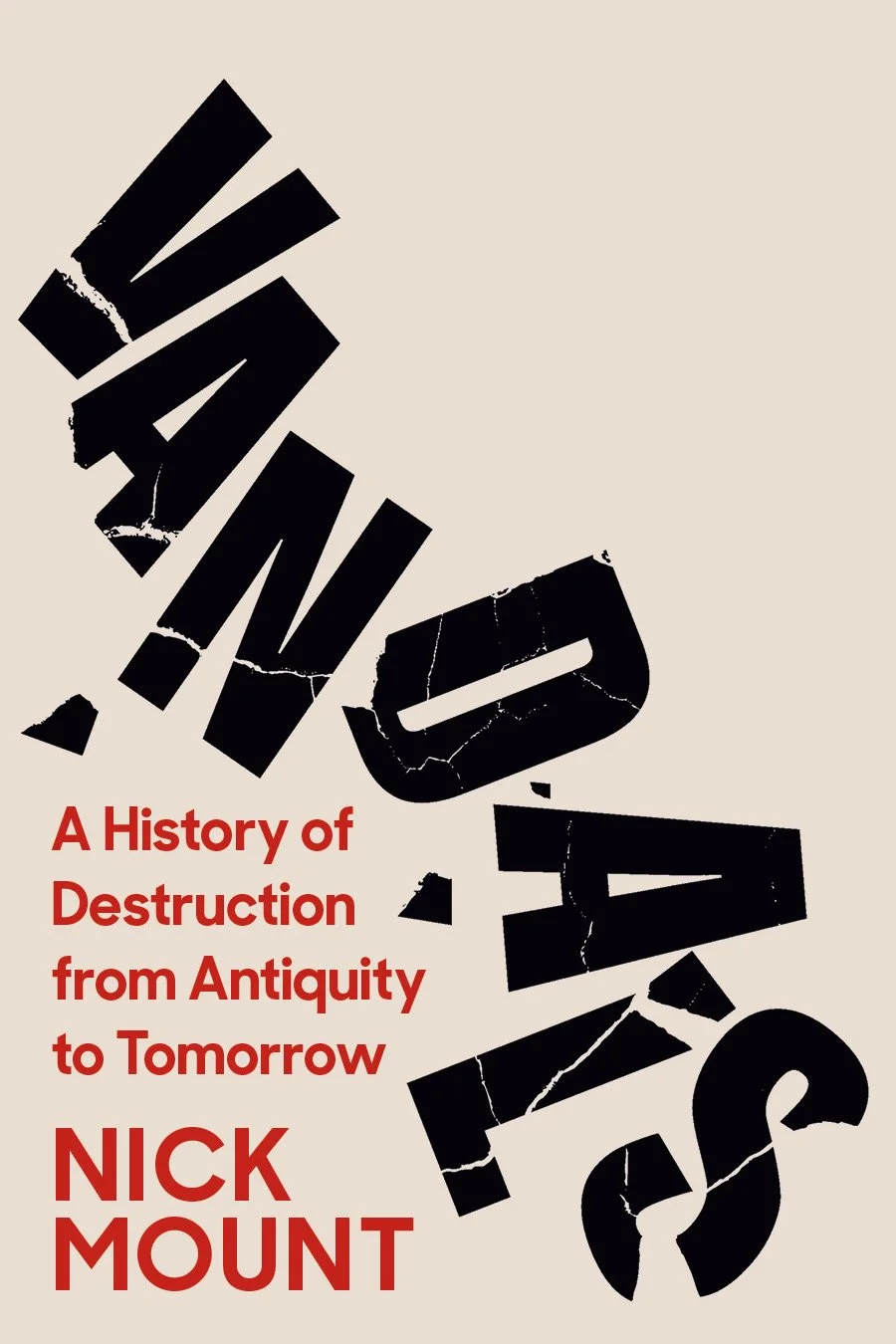
Advance praise…
"Magnificent. An eloquent and exhaustive account of not only the worst things humans do to each other and the things they create, but why."
-Paul Theroux, New York Times bestselling author of The Great Railway Bazaar
“Like Sapiens and The Dawn of Everything before it, Nick Mount’s Vandals will reshape our shared understanding of history and the world we live in now….Vandalism is a future classic.”
—Jared Bland, former Publisher, M&S
“Always able to paint—vividly—the “big picture” and to tell—engagingly—the best story, Nick Mount is the ideal person to bring together—with lucidity and passion—all the specialist scholarly research on humanity’s manifest appetite for destruction with the history and theory of human civilization. The result will be ground-breaking.”
—Linda Hutcheon, past president, MLA
From the introduction…
This book is a history of destruction. Not the natural kind, but the unnatural kind: the kind often done in the name of gods, but always by human hands. It is the first history of the deliberate destruction of property, both acts we have learned to call “vandalism” and the infinitely more destructive acts we have learned to explain and excuse by other names, like “war,” “conquest,” and “development.” It uses the dictionary definition of vandalism: the willful or malicious destruction or defacement of public or private property. But unusually, it takes that definition at face value.

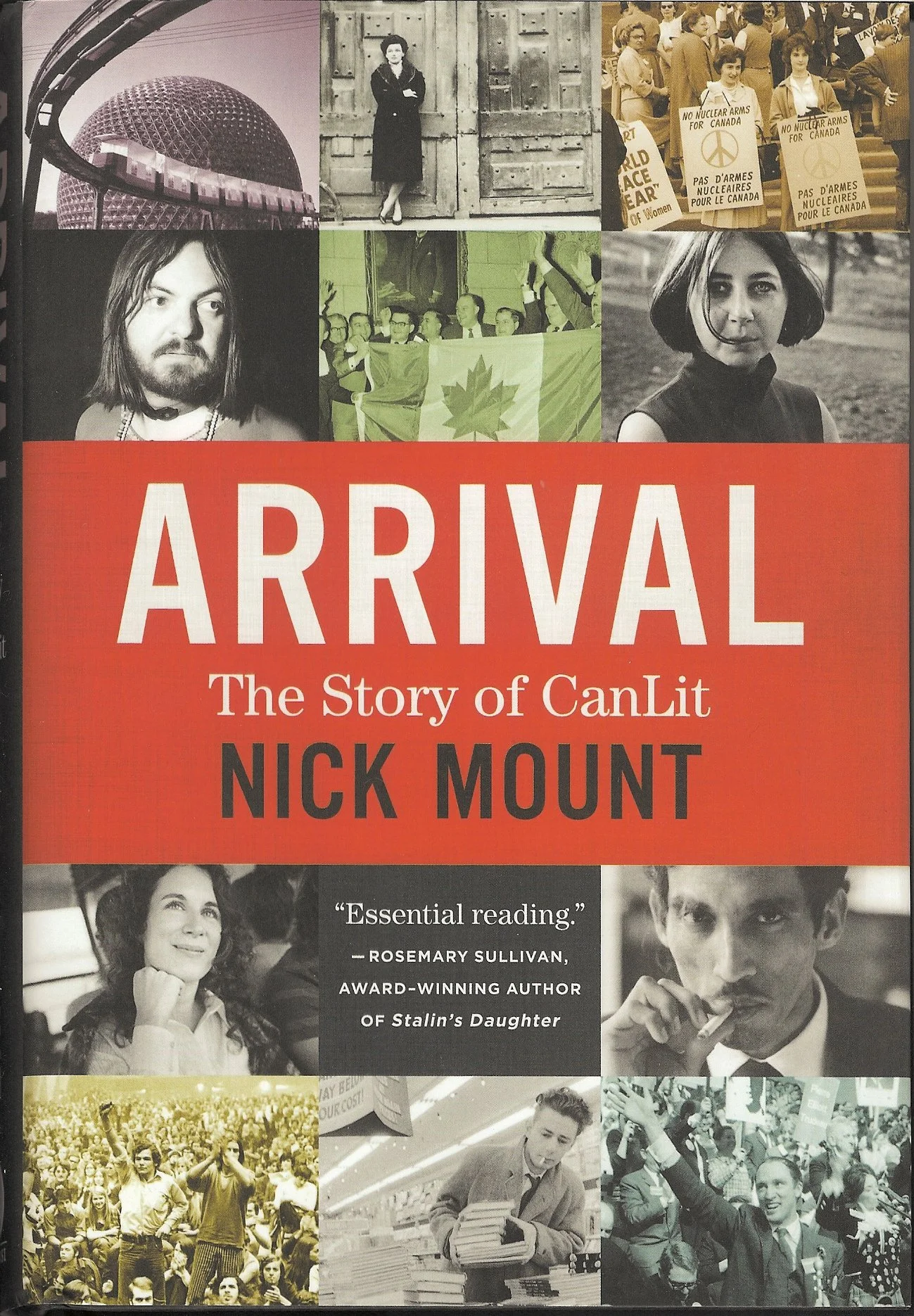
From the preface…
I wrote this book because it didn’t exist. We have many excellent biographies of the writers who emerged during what came to be called the CanLit boom. We also have some good histories of the publishing side of the story in both English and French Canada, and a great many books about the time itself. What we don’t have is a book that puts all those stories together. This is the first book to try to do that, to tell the whole story, for both those who know parts of it and those who know none of it. It’s a book is about the past, but like all such books, it’s for the present, a book that I hope helps explain how we got from there to here, from a country without a literature to a literature without a country.
“The most important book to be written in more than forty years about the rise of Canadian literature….Arrival brims and crackles, in equal measure, with information and energy.”
—Winnipeg Free Press
“Arrival is a wonderful act of re-creation; it simply could not be bettered. It is fascinating from page to page, measured but mesmerizing”
—Canadian Notes & Queries
“There’s passion in these pages that’s genuinely infectious to read”
—National Post
National bestseller and Globe and Mail and National Post best book of the year
From the introduction…
In the last decades of the nineteenth century, powerful obstacles to a domestic literature together with powerful attractions to other literary centres caused most Canadian writers who mattered, and many who didn’t, to leave Canada, most for the United States, most of those for New York. As a profession, as the inspiration for a domestic literature, and as the groundwork of a national canon, Canadian literature began here: not in the backwoods of Ontario, not on the salt flats of New Brunswick, but in the cafés, publishing offices, and boarding-houses of late-nineteenth-century New York.
“Meticulously researched and engagingly written.”
—Jeffrey Wollock
“A fascinating study that should be read by every student of our literary foundations.”
—R. Gordon Myles, Canadian Book Review Annual
“I think you missed a comma on page 12”
—Mom
2005 Gabrielle Roy Prize for the best book in Canadian literary criticism
Select Articles
“Tradition and the Individual Canadian Talent.” Studia Anglica Posnaniensia (Poland) 55.2 (2020)
“This One Goes to Eleven: The Fictional World of André Alexis.” Canadian Notes & Queries 108 (2020-21)
Introduction, Civil Elegies and Other Poems, by Dennis Lee. Toronto: Anansi, 2012.
“Lana Del Rey, Meet Your Boyfriend.” Ryeberg Live, Drake Hotel, Toronto, March 19, 2012.
“Searching for Banksy.” Queen’s Quarterly 117.2 (summer 2010). An earlier version of this article about the British street artist’s first works in Canada appeared in the Torontoist.
“Listening to Tom Dawe.” Queen’s Quarterly 117.1 (spring 2010). An interview with the Newfoundland poet.
“What Thunder Bay Burned: How Lady Chatterley Wrote Our Obscenity Law.” Walrus, Jan-Feb. 2010.
“On Hugh’s Watch: The Watch That Ends the Night Turns Fifty.” Walrus, July-Aug. 2009.
“Waiting for Godot without Existentialism.” Raritan 28.2 (fall 2008). About Beckett’s play.
“The Renaissance of Cute.” Walrus, Sep. 2008. About street art.
“The Return of Beauty.”Queen’s Quarterly 115.2 (summer 2008), reprinted in 2019. This article–also partly about street art–won a National Magazine Silver Award.